

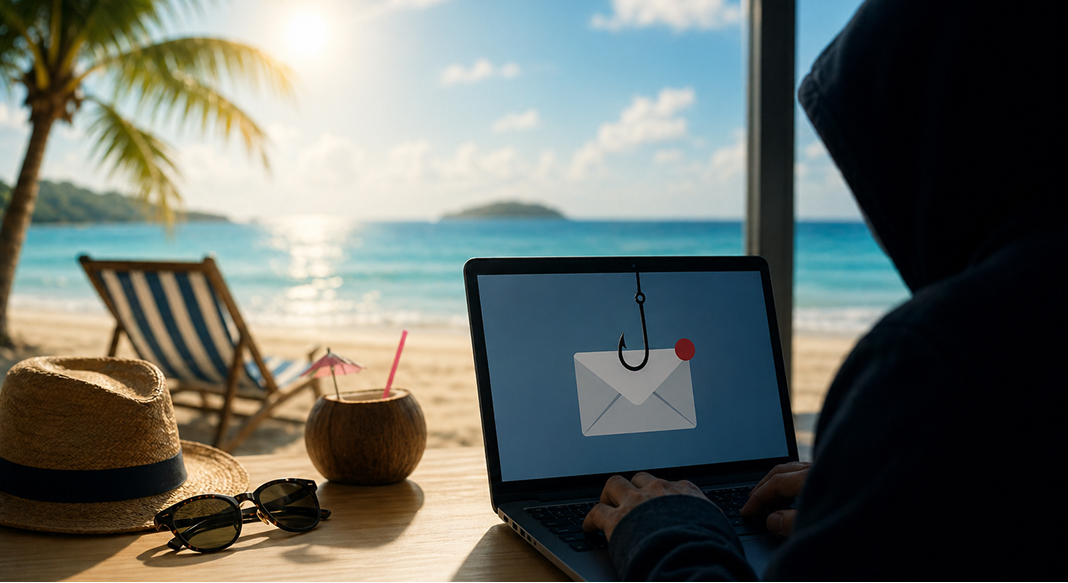
Your Out-of-Office Reply Is a Hacker’s Best Friend
When most people think about cyberattacks, they picture a suspicious email landing in their inbox. A phishing link. A fake login page. The threat is something that comes at you, and your job is to spot it.
But what if you’re not the target? What if you’re the disguise?
That’s the part most people never consider. An attacker doesn’t always need to trick you directly. Sometimes, all they need is enough information about you to convince someone else – your colleague, your manager, your backup – that they are you. And there’s one place where millions of employees hand over exactly that kind of information, automatically, to anyone who sends them an email: the out-of-office reply.
The Most Polite Security Mistake You’ll Ever Make
Your name, your role, the exact dates you’ll be away, who’s covering for you, and sometimes even your personal phone number – all neatly packaged and sent to every sender, including people you’ve never met. That’s not just an auto-reply. That’s an intelligence briefing.
Attackers use this information to launch Business Email Compromise (BEC) attacks – impersonating the absent employee to trick the backup contact into transferring money, sharing credentials, or granting access. According to the FBI’s 2025 Internet Crime Report, BEC cost American organizations over $3 billion last year alone, making it the second most financially damaging form of cybercrime in the country.
The OOO message scripts the entire attack. The attacker knows you’re unreachable, knows who’s filling in, and has a built-in excuse for urgency: “I’m traveling and can’t call – can you handle this before end of day?”
Why We Do It Anyway
Most security awareness focuses on what not to give an attacker: don’t share your password, don’t click suspicious links, don’t enter your credentials on unfamiliar sites. We’re trained to protect the keys to our own accounts.
But we rarely think about a different kind of information – the kind that doesn’t let someone break into our account, but lets them pretend to be us. Your job title, your schedule, your colleague’s name, your tone of communication. None of these are secrets. None of them feel sensitive. But together, they give an attacker everything they need to write a convincing email as you – to someone who trusts you.
That’s why out-of-office replies are such a perfect blind spot. Nobody writes one thinking about security. It feels like a small act of professionalism – and in most workplaces, it is. The problem isn’t that people are careless. It’s that impersonation simply isn’t on their radar.

Summer Is Coming – And Attackers Know It
OOO messages are a year-round risk, but they peak predictably. Holiday seasons, summer breaks, school vacations – these are the periods when entire departments go on leave, OOO replies flood inboxes, and backup contacts juggle responsibilities they wouldn’t normally handle.
Attackers know these patterns. They don’t need insider access to predict when a finance team will be short-staffed or when a VP will be unreachable for a week. The OOO messages tell them directly – and all it takes is a single email to trigger one.
The result is a coordinated window of vulnerability: key decision-makers are away, the people covering for them are stretched thin, and the usual checks and balances get shortcut in the name of keeping things moving.
It’s Bigger Than an Auto-Reply
Out-of-office replies are just one example. But the pattern they reveal is much bigger.
We tend to think of cyberattacks in narrow terms – a phishing email, a malicious link, a stolen password. That framing trains us to look for one kind of threat and protect one kind of information. But attackers don’t think in categories. They collect whatever is available – a job title here, an absence there, a colleague’s name from a LinkedIn post – and build a picture that lets them act as someone you trust.
The real shift isn’t about writing a better auto-reply. It’s about developing a habit of thinking critically about any piece of information you share – even the ones that don’t feel like a risk. Especially the ones that don’t feel like a risk. Because that’s exactly where attackers look first.
This article was written by Cywareness, a company specializing in cybersecurity awareness.
As part of its mission, Cywareness continues to monitor emerging trends, analyze real-world attacks, and share practical insights to help organizations stay ahead in today’s evolving threat landscape.